


Understanding MinLine™
The Least Scar Necessary. Never at the Expense of Beautiful Shape.
Dr. Elise Min's philosophy for breast lift and breast reduction.
The MinLine™ Philosophy
At its heart, MinLine™ is built on a simple belief: every woman deserves the operation that’s right for her.
It isn’t about avoiding an anchor scar at all costs, nor is it about using the shortest scar possible. It’s about choosing the incision pattern that creates the best balance between breast shape, support, scar quality, and long-term durability.
That means many women are excellent candidates to benefit from the MinLine™ philosophy, while others are better served with a traditional anchor pattern. My responsibility isn’t to perform the same operation on every patient. It’s to recommend the operation that best fits your anatomy and your goals.
For me, MinLine™ represents more than a scar pattern. It reflects my philosophy of individualized surgery, careful judgment, and intentional scar design.
The least scar necessary. Never at the expense of beautiful shape.
One of the most common concerns women have when considering a breast lift or breast reduction is the scar. While many patients naturally focus on whether they’ll need an anchor scar, I believe the more important question is whether that scar is truly necessary.
MinLine™ grew from that philosophy. Rather than asking how to create the shortest scar possible, I focus on choosing the scar pattern that provides the best balance of breast shape, support, scar quality, and lasting results.
MinLine™ isn’t defined by a single incision pattern. It’s a philosophy of scar design that uses the least scar necessary while never compromising beautiful breast shape, lasting support, or patient safety.
Why Scar Design Matters
Every incision creates tension. Every closure heals differently. Every scar influences the final shape of the breast.
Scar design isn’t simply about aesthetics. It’s also about engineering.
When tension is distributed well, scars often heal more favorably and breast shape is better supported over time. When tension is concentrated in one area, scars may widen, stretch, or become more noticeable as healing progresses.
That’s why scar design deserves just as much thought as implant selection, breast shaping, or nipple position.
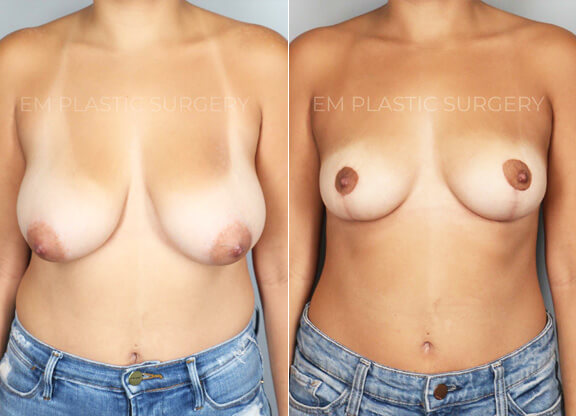
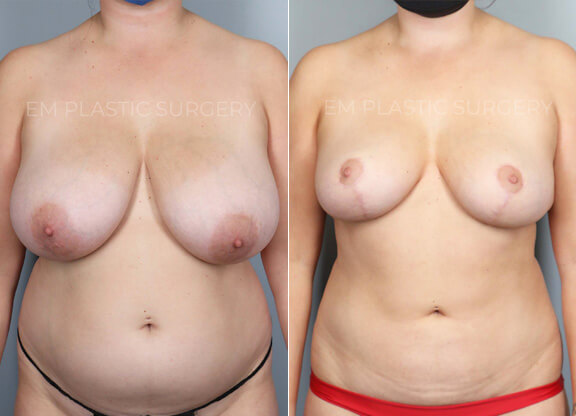
No matter how big your breasts are, the amount of tissue that a plastic surgeon can remove is dependent on your body and what the breasts can handle. Generally speaking, the larger your breasts are, the less likely you can breastfeed if you go super small. If breastfeeding is something you’d like to do in the future, definitely consider your options with your plastic surgeon and raise your concerns!
Dr. Min reflects on a recent breast reduction surgery performed on an 18-year-old patient. Originally a triple D cup, the patient’s breasts were reduced to a C cup, which was her desired size. The decision to limit the reduction was based on essential considerations like preserving blood vessels and milk ducts, ensuring nipple health, and maintaining the potential for breastfeeding in the future
The Three Traditional Scar Patterns
There is no single “best” scar pattern for every woman. Over the years, several techniques have been developed, each with its own strengths and limitations. The right choice depends on your anatomy, skin quality, breast size, and the amount of lifting or reduction required.
Quick Comparison
| Comparison | Vertical (Lollipop) | L-Pattern / J-Pattern | Wise Pattern (Anchor) |
|---|---|---|---|
| Scar Length | ★★★ Shortest | ★★ Moderate | ★ Longest |
| Breast Shape Control | Excellent | Excellent | Excellent |
| Best For | smaller, lighter breasts with less lax skin | Many moderate to large lifts / reductions | Very large breasts or significant skin excess with nipple positioned at the belly button or below |
| Tension Distribution | Concentrated at lower closure that leads to increased scar footprint over time. | More evenly distributed | Well distributed |
| Horizontal Scar | None | Short | Full inframammary fold |
| Trade-offs | Risk of widening at the lower scar | Slightly longer scar, improved tension distribution | Longest scar, maximum skin removal |
No single scar pattern is right for every woman. This comparison is intended to illustrate the strengths and trade-offs of each technique. The best choice is always determined by your anatomy, your goals, and the result we’re trying to achieve together.
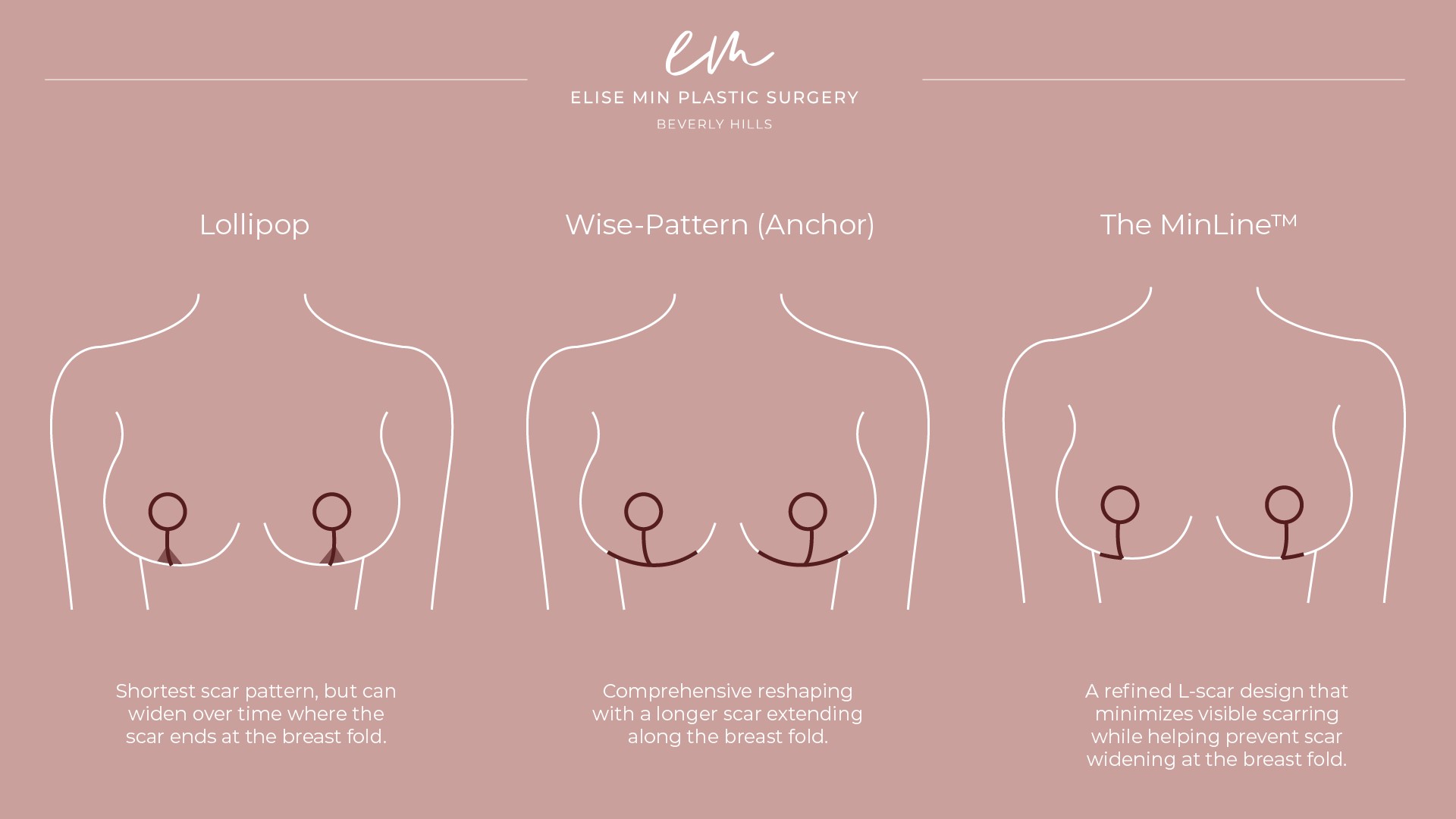
MinLine™ is not a new incision pattern. It is Dr. Elise Min’s philosophy of scar design, emphasizing individualized technique selection, thoughtful tension distribution, and the least scar necessary without compromising breast shape or support.
The Vertical (Lollipop) Pattern
The vertical, or “lollipop,” scar consists of an incision around the areola with a vertical line extending to the breast crease. It became increasingly popular because it avoids the longer horizontal scar beneath the breast while allowing excellent reshaping in many patients.
Advantages
Shorter overall scar
Excellent breast projection and shaping
- Avoids a long incision within the breast fold
Limitations
Because the closure ends at a single point at the breast crease, tension may become concentrated at the bottom of the scar, sometimes leading to widening or a broader, triangular scar footprint. It may also be less suitable for patients with significant skin excess or very large breasts.
The Wise Pattern (Anchor)
The Wise-pattern, commonly known as the anchor scar, adds a horizontal incision along the inframammary fold in addition to the vertical and areolar incisions. It remains one of the most versatile and widely performed breast lift and breast reduction techniques.
Advantages
- Excellent control of breast shape
- Well suited for larger reductions and more significant skin excess
- Reliable long-term support in appropriately selected patients
Limitations
The horizontal scar extends farther along the breast fold and may be more visible in certain clothing, swimwear, or low-cut tops. While many patients heal beautifully, not every woman requires a scar of this length to achieve an excellent result.
The L-Pattern (or J-Pattern)
Although many patients are unfamiliar with it, L-pattern and J-pattern breast reductions have existed in plastic surgery for decades. Rather than extending the horizontal scar across the entire breast fold, these techniques include a shorter horizontal extension on one side of the breast.
Historically, the L-pattern has served as an intermediate option between a traditional vertical reduction and a full Wise-pattern reduction. It allows surgeons to redistribute tension while limiting the length of the horizontal scar in appropriately selected patients.
Like every breast reduction technique, the L-pattern is not appropriate for every woman. Its success depends on careful patient selection, careful surgical planning, and meticulous execution.
How MinLine™ Evolved
I didn’t set out to create a new scar pattern.
L-pattern and J-pattern breast reductions have been part of plastic surgery for decades, and like many surgeons, I trained using well-established techniques for both breast lift and breast reduction. Each has clear advantages, and each has situations where it works beautifully.
My background in reconstructive microsurgery taught me that every incision matters. The way tissue is handled, the way tension is distributed, and the way wounds heal all influence the final result. Those same principles eventually shaped how I began thinking about breast lift and breast reduction scars.
As my experience grew, so did my appreciation for scar healing and lasting breast shape. While I appreciated the shorter scar of the traditional vertical, or “lollipop,” approach, I wasn’t always satisfied with how the lower portion of the scar matured. In some patients, the vertical closure widened into a broader, more triangular footprint at the base of the breast. At the same time, I questioned whether every woman truly needed the longer horizontal scar of a full anchor pattern.
I wasn’t searching for a new operation. I was searching for a better way to solve a recurring problem.
Rather than viewing scar patterns as fixed techniques, I began thinking of them as tools that could be adapted to each individual woman. I found myself returning to the same principles over and over again: using the least scar necessary, distributing tension more evenly across the closure, and recognizing that scar placement is just as important as scar length.
In carefully selected patients, incorporating a short horizontal extension within the natural breast fold allowed me to redistribute tension while preserving beautiful breast shape. Just as importantly, I became increasingly intentional about where that horizontal scar was placed, recognizing that not all portions of the breast fold are equally visible in clothing or swimwear.
Over time, those principles became more than technical refinements. They became a philosophy.
I call that philosophy MinLine™.
MinLine™ isn’t defined by a single incision pattern. It’s a way of thinking about breast lift and breast reduction surgery—using the least scar necessary while never compromising breast shape, lasting support, safety, or scar quality.
Scar Placement Is Just As Important As Scar Length
When patients think about scars, they naturally focus on how long the scar will be. But as a surgeon, I think just as much about where that scar is placed.
Not all portions of the breast fold are equally visible. The inner, or medial, portion of the fold is more likely to be seen in low-cut tops, bikinis, plunging necklines, and certain bras. The outer portion is naturally better concealed along the curve of the breast and chest wall.
That distinction matters.
Whenever it can be done safely without compromising breast shape or support, I intentionally position the horizontal component where it is least likely to be visible. Sometimes, a slightly longer scar that’s carefully placed is actually less noticeable than a shorter scar that’s under excessive tension or located in a more visible area.
This is one of the principles that guides MinLine™.
For me, beautiful scar design isn’t simply about making scars shorter. It’s about making intentional decisions that help scars heal well, remain discreet, and support a beautiful breast shape for years to come.
Who May Benefit From MinLine™?
Many women seeking a breast lift or breast reduction are candidates for MinLine™ philosophy, often more than they realize. In my practice, many women who have been told they need an anchor scar are surprised to learn they’re candidates for MinLine™.
In fact, one of the most common stories I hear is, “I was told I needed an anchor scar.” While a traditional Wise-pattern reduction remains the best operation for some women, it isn’t the only option for everyone. I’ve cared for many patients who were told a full anchor scar was necessary but were ultimately excellent candidates for a shorter scar than they had been told was possible.
That’s because the decision isn’t based on breast size alone. Skin quality, tissue characteristics, breast shape, nipple position, and your overall anatomy all influence which scar pattern will provide the best result.
The MinLine™ philosophy often allows me to achieve beautiful breast shape with a shorter horizontal scar while maintaining long-term support. However, there are situations where a traditional anchor incision remains the safest and most reliable choice. My recommendation is always based on what will give you the best outcome—not on applying the same technique to every patient.
If you’ve been told an anchor scar is your only option, it’s worth having a second opinion about whether another approach may be appropriate for your anatomy.
Every Scar Tells A Story
Every breast lift and every breast reduction leaves a scar.
My responsibility isn’t to pretend otherwise.
Scar design has become one of the parts of breast surgery I care about most because I believe a beautiful result isn’t defined only by the shape of the breast, but also by how intentionally the incision is planned and how beautifully it heals.
To me, that’s what MinLine™ has always been about: using the least scar necessary to create beautiful breast shape, lasting support, and scars that become a quiet part of the story rather than the focus of it.
Frequently Asked Questions About MinLine™
Is MinLine™ better than an anchor scar?
A traditional Wise pattern breast reductions remains the best operation for some women, particularly those with significant skin excess or those with nipples that sit at the belly button level or lower. The MinLine™ philosophy is particularly helpful for women who can achieve the same beautiful breast shape and long-term support without extending the scar across the entire breast fold. The goal is never to avoid an anchor scar at all costs. It’s to choose the operation that’s right for you.
Is MinLine™ the same as an L-pattern breast reduction?
MinLine™ is built upon principles that have existed in plastic surgery for many years, including the L-pattern breast reduction. I don’t claim to have invented the L-pattern. Rather, MinLine™ represents my philosophy of applying these principles thoughtfully, with particular attention to tension distribution, scar placement, and long-term scar quality. It’s less about a specific incision and more about how I decide when and how to use it.
Why not perform a vertical (lollipop) breast reduction on everyone?
I prefer to perform the vertical technique on my patients with smaller, lighter breasts with robust skin that has minimal laxity. That said, in my experience, concentrating all of the closure at the bottom of the vertical scar can sometimes lead to widening or a broader triangular scar footprint as healing progresses. Adding a short horizontal extension can redistribute that tension in appropriately selected patients while preserving beautiful breast shape.
Why can't everyone avoid an anchor scar?
Because every woman’s anatomy is different. Patients with significant skin laxity, very large breasts, or those with nipples sitting very low on the torso at the level of the belly button or below may achieve a safer or more predictable result with a traditional wise-pattern reduction. My responsibility isn’t to avoid an anchor scar whenever possible. It’s to recommend the operation that will provide the best long-term outcome.
Does MinLine™ leave less visible scars?
In many patients, yes. One of the principles behind MinLine™ is that scar placement is just as important as scar length. Whenever it can be done safely, I keep the horizontal component shorter and position it where it is naturally less noticeable in clothing and swimwear. While no surgeon can promise an invisible scar, intentional scar design can make a meaningful difference.
Can MinLine™ be used for breast lifts as well as breast reductions?
Yes. The MinLine™ philosophy applies to both breast lift and breast reduction surgery. Depending on your anatomy, it may guide me toward a refined L-pattern closure or, when appropriate, a traditional anchor pattern. During your consultation, we’ll determine which approach will provide the best combination of breast shape, support, and scar quality.
Why isn't MinLine™ offered everywhere?
MinLine™ isn’t a completely different operation—it’s a different way of thinking about scar design. It requires careful patient selection and a willingness to individualize the operation rather than relying on the same scar pattern for every patient. While many surgeons use vertical, L-pattern, and Wise-pattern techniques, my focus has been on refining when each approach is most appropriate and how scar design can be optimized for both appearance and long-term healing.
Case Studies of Real Patient Results
Case Study #1: Breast Reduction With Lollilop Incision
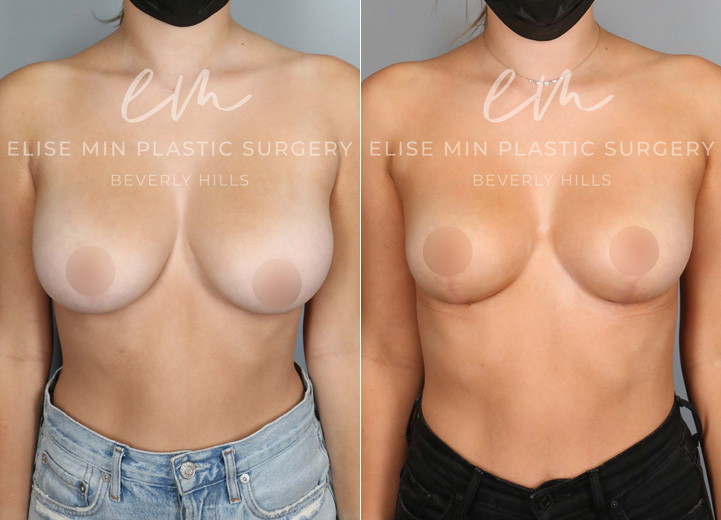
This is a 22 year-old woman with 32DD breasts who felt that her breasts did not match her petite torso. She was experiencing neck and back pain and ideally wanted to be a C cup. The patient underwent a small breast reduction (130g removed from each breast), which included a breast lift procedure. She had the procedure done using a minimal scar approach with a lollipop incision. This is a good example that every breast reduction patient receives a breast lift procedure to achieve perkier breasts.
Case Study #2: Breast Reduction DDD to C Cup
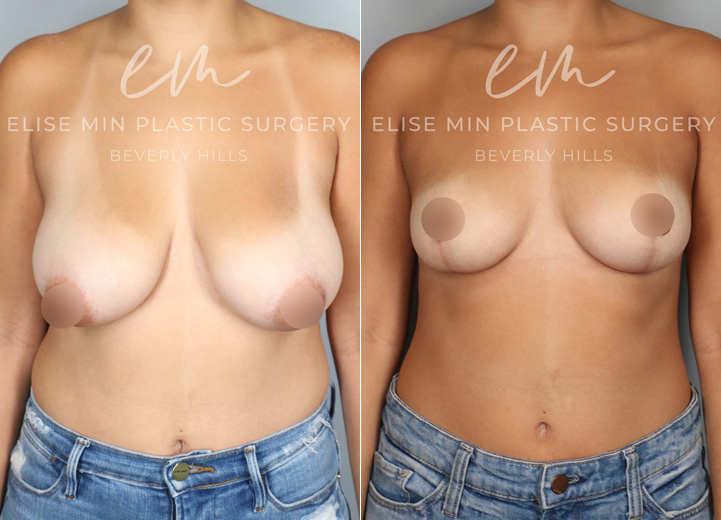
This is a petite 33-year-old woman who had been considering a breast reduction procedure for many years. She felt that her breast size did not match her petite frame and experienced the weight of her droopy breasts affecting her posture over the years. She underwent a vertical breast reduction with the minimal scar approach (‘lollipop’-scar) and had 173g removed from the left breast and 139g removed from the right breast. She went from 30DDD cup-sized breasts to her desired C cup-size after the procedure. She was excited to share that her posture improved, and feeling a lot lighter in the chest, she’s enjoying not wearing a bra at all.
Case Study #3: DD to C Reduction with Internal Bra
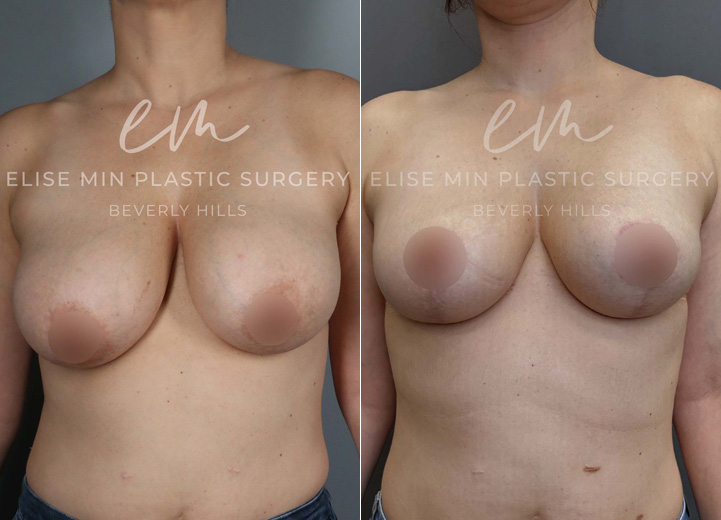
This 40-year-old patient had DD-sized breasts and desired a C cup for a lighter, more comfortable fit. She underwent a breast reduction, with 250g and 270g of tissue removed from each breast, achieving a more proportionate shape. To enhance long-term support, she also opted for synthetic absorbable mesh (Galaflex) as an internal sling, often called an “internal bra.”


