

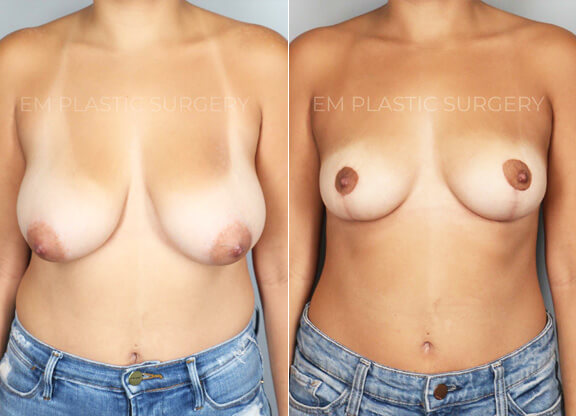
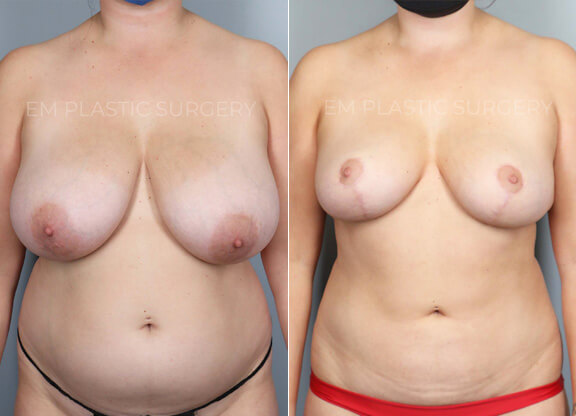

Breast Reduction in Beverly Hills
Comfort Restored. Confidence Renewed. Beautifully Balanced.
Breast reduction has always been one of my favorite operations because it improves much more than breast size. It changes the way women move through everyday life.
Many patients first come to see me because of neck or shoulder pain, difficulty exercising, bra strap grooving, or frustration that clothes never seem to fit the way they should. Those concerns are very real, and reducing the weight of the breasts often brings remarkable physical relief.
What surprises many women is how much changes beyond the physical symptoms. They tell me they stop planning outfits around their chest. They feel comfortable walking into a workout class. Shopping becomes enjoyable again. The breasts simply stop being something they think about every day.
When I hear a patient tell me, ‘I finally feel like my body fits me,’ I know we’ve accomplished much more than making her breasts smaller.
Breast Reduction Is About More Than Size
One of the first things I tell patients is that breast reduction is not simply an operation to remove tissue.
I’m thinking about proportion, balance, and longevity. I’m asking what size will feel natural on your frame, how your breasts are likely to change over time, and what operation will give you the best long-term result. Over the years, I realized the better question wasn’t, “How can I make the scar shorter?” It was, “What operation will give this patient the best long-term result?”
Every woman comes with a different story. Some are primarily seeking relief from physical discomfort. Others have lived with noticeable asymmetry. Some simply want their outside appearance to better reflect how they already feel inside.
Those goals matter because they shape every recommendation I make.
No matter how big your breasts are, the amount of tissue that a plastic surgeon can remove is dependent on your body and what the breasts can handle. Generally speaking, the larger your breasts are, the less likely you can breastfeed if you go super small. If breastfeeding is something you’d like to do in the future, definitely consider your options with your plastic surgeon and raise your concerns!
Dr. Min reflects on a recent breast reduction surgery performed on an 18-year-old patient. Originally a triple D cup, the patient’s breasts were reduced to a C cup, which was her desired size. The decision to limit the reduction was based on essential considerations like preserving blood vessels and milk ducts, ensuring nipple health, and maintaining the potential for breastfeeding in the future
How I Think About Breast Reduction
If you and I were standing together in front of the mirror during consultation, I wouldn’t immediately start talking about cup size or scars.
Instead, I’d show you what I’m looking at.
I would point out how your skin supports your breasts, where your breast tissue sits, how your nipples are positioned, and how each of those details influences the operation I recommend.
This is often the moment when patients begin to understand their anatomy in a completely different way. They realize that two women with the same bra size may need entirely different operations because their tissues behave differently.
I believe patients make better decisions when they understand not only what I recommend, but why.
A Reconstructive Foundation
Although most women come to me seeking cosmetic breast reduction, the way I think about breast surgery has been shaped by my fellowship training in reconstructive microsurgery. Caring for women undergoing breast reconstruction taught me to think carefully about blood supply, tissue support, and long-term healing. Those same principles continue to guide every cosmetic breast reduction I perform because beautiful results aren’t simply created in the operating room. They’re created by respecting the anatomy from the very beginning.
The Story Behind MinLine™
Patients often ask me whether they’ll need an anchor scar. I understand why. It’s usually one of the first things people search online before they ever meet with a plastic surgeon.
My answer is almost always the same: before we talk about the scar, let’s talk about your anatomy.
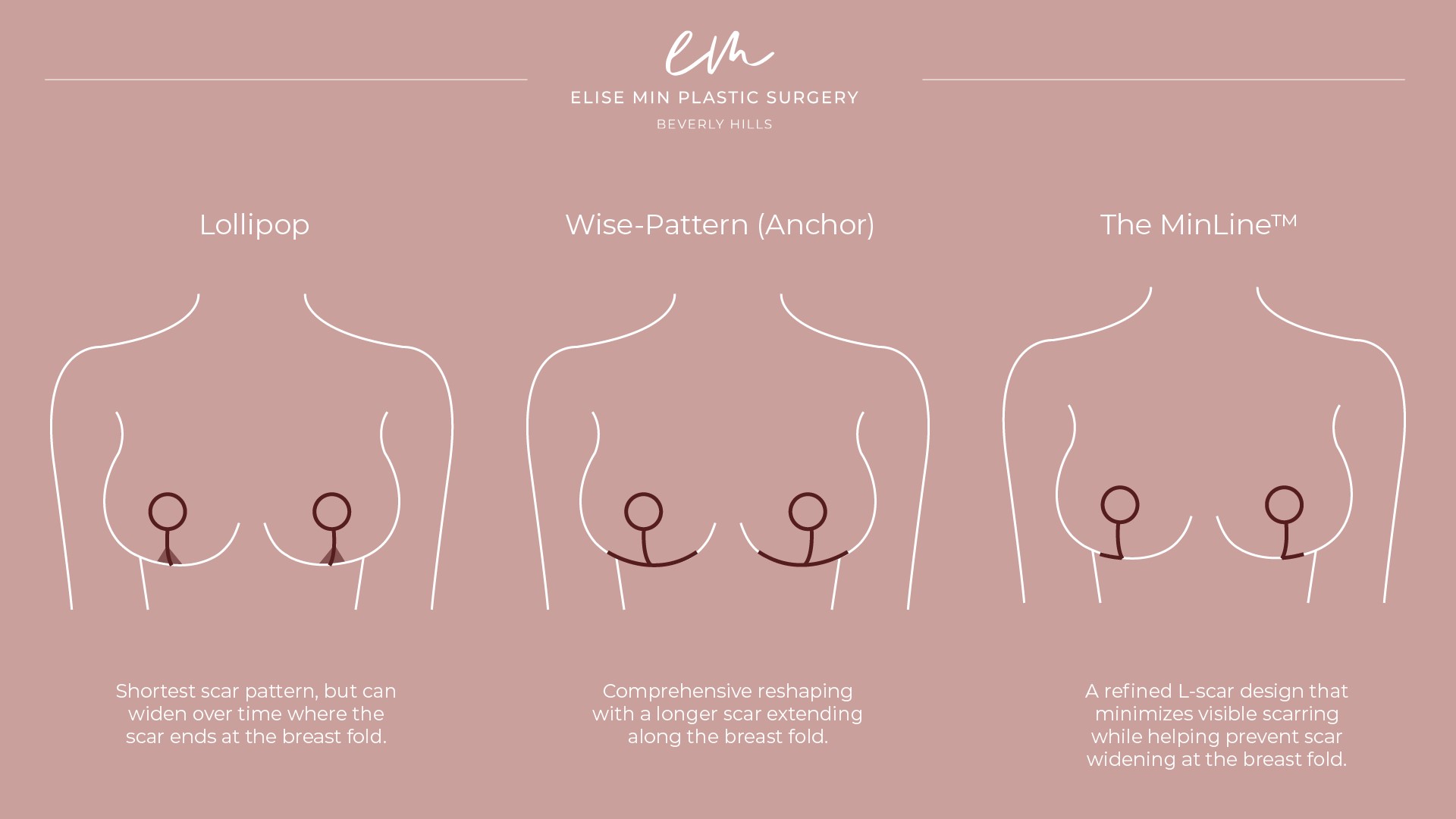
Early in my career, I appreciated the shorter vertical, or “lollipop,” scar because it avoided the horizontal incision beneath the breast. As I began paying closer attention to how those scars matured over time, in some women, concentrating tension at the bottom of the vertical incision led to significant widening of the scar footprint that I felt could be improved.
At the same time, I questioned the opposite approach. Did every woman really need a full Wise-pattern reduction? For some women, the answer was yes. In others, I found I could achieve an equally beautiful breast shape without carrying the incision across the entire inframammary fold.
Those experiences gradually changed the question I asked myself in the operating room.
Instead of asking, “Which scar pattern do I prefer?” I began asking, “Which operation gives this patient the best chance of a beautiful, lasting result with the least amount of scar in both length and surface area?”
That question became the foundation of my MinLine™ Philosophy.
“Scar placement is just as important as scar length.”
To me, MinLine™ is not an incision. It is a way of thinking. It means respecting each woman’s anatomy, choosing the operation that best fits her tissues, and using the least scar necessary without compromising breast shape, long-term support, blood supply, or safety.
Some patients are excellent candidates for a traditional vertical, or “lollipop,” breast reduction. Others are best served with a refined modified L pattern closure, while some benefit most from a traditional Wise-pattern reduction. None of these operations is inherently better than another. What matters is selecting the approach that best fits your anatomy and provides the most beautiful, durable result.
If you ever hear me spending more time talking about the scar than the breast shape, I’ve probably lost sight of what really matters. The incision is simply the pathway. The destination is a breast that looks natural, feels balanced, and continues to age well for years to come.
Want to learn more about MinLine™ and how it compares with traditional scar patterns?
Your Consultation Experience
Every consultation begins the same way: by listening.
Before I examine you, I want to understand what has brought you into my office. Maybe you’ve struggled with neck and shoulder pain for years. Maybe you’ve stopped wearing certain clothes. Maybe you’re simply tired of feeling out of proportion. There isn’t a right or wrong reason to consider breast reduction. My job is to understand what matters most to you.
Once we’ve talked, we’ll stand together in front of a mirror. This is where I spend much of my time teaching. I’ll point out what I see, explain how your skin supports your breasts, where your breast tissue is concentrated, how your nipples are positioned, and why those details influence my recommendations.
One of my favorite moments during consultation is watching patients look at themselves differently in the mirror. Once they understand their anatomy, my recommendations usually make much more sense.
We’ll also review before and after photographs of women with body types similar to yours. Rather than trying to match a bra size, we’ll focus on proportion. Cup sizes vary widely between manufacturers, but balance is something we can both see.
By the end of our visit, I don’t simply want you to know what operation I recommend. I want you to understand why I believe it’s the best operation for you.
Recovery
I tell patients that recovery is part of the operation, not something that happens after it.
Before surgery we’ll review what to expect, how to care for your incisions, and the milestones you’ll experience during healing. Knowing what is normal makes recovery much less stressful.
Most women are pleasantly surprised by how quickly they begin feeling lighter. You’ll be walking the day of surgery, and over the following days you’ll gradually return to your normal routine. Healing, however, continues long after you start feeling better.
That’s why I follow my patients closely. Early visits focus on circulation, swelling, and incision healing. As time goes on, our conversations shift toward scar maturation, breast shape, symmetry, and the subtle changes that occur as the tissues soften and settle.
Questions don’t always arise during an office visit, which is why my patients also have access to our secure HIPAA compliant messaging platform. Whether you’d like me to review a photograph or simply want reassurance that something looks normal, my team and I are here to help.
Some of the most beautiful results I see are not at six weeks, but at six months and beyond. My goal is to support you throughout that journey so your recovery is every bit as thoughtful as the operation itself.
FAQs
Will I lose nipple sensation?
This is one of the most common questions I hear.
Most women maintain normal or near normal nipple sensation after breast reduction, although temporary numbness is very common while the nerves recover. Permanent changes are possible, particularly with larger reductions, but I perform every operation with careful attention to preserving the blood supply and nerve pathways whenever it’s safely possible. We’ll discuss your individual anatomy and what I think your specific risks are during consultation.
Will I be able to breastfeed?
Many women are able to breastfeed after breast reduction, but no surgeon can guarantee it.
Future breastfeeding depends on your anatomy, the amount of tissue removed, and the operation that’s appropriate for you. Whenever possible, I preserve the structures that support breastfeeding, but it’s important to understand that milk production can be reduced after surgery.
Should I wait until after having children?
There isn’t one right answer.
If your breasts are causing significant discomfort now, there can be real benefits to having surgery before pregnancy. Pregnancy and breastfeeding may change your breasts over time, so we’ll discuss your future family plans and decide together what makes the most sense for you.
Will my breasts grow back?
The breast tissue removed during surgery does not grow back.
Your breasts can still change over time because of pregnancy, weight changes, hormones, menopause, and aging. My goal is to create a result that remains balanced and natural throughout those changes.
Am I too young?
Age alone doesn’t determine whether you’re a good candidate.
The more important questions are whether your breasts have finished developing, how much your symptoms affect your daily life, and whether you understand the long-term considerations of surgery.
How do I choose my size?
Most women don’t come to consultation knowing exactly what cup size they want, and that’s completely normal.
Rather than focusing on a letter, we’ll focus on proportion. Together we’ll review photographs of women with similar body types and decide what looks balanced for your frame.
Will insurance cover my surgery?
That depends on your insurance plan and whether you meet its medical necessity criteria.
My team will help determine whether you’re a candidate for insurance coverage and guide you through the authorization process if appropriate.
Will my scars fade?
Yes.
Scars continue to mature for 12 to 18 months after surgery. While no scar disappears completely, thoughtful incision placement, meticulous surgical technique, and a comprehensive scar management program all help optimize how your scars heal.
Will I have an anchor scar?
Not necessarily.
Some women are excellent candidates for a traditional vertical, or lollipop, breast reduction. Others are better served with a modified L pattern closure, while some truly benefit from a traditional Wise-pattern reduction.
The MinLine™ Philosophy isn’t about avoiding an anchor scar. It’s about choosing the operation that best fits your anatomy while using the least scar necessary to create a beautiful, long-lasting result.
Your Next Step
If you’ve been thinking about breast reduction for a while, you’re not alone. Most of the women I meet have been considering surgery for years before scheduling a consultation.
My goal is never to convince you that surgery is the right choice. It’s to help you understand your anatomy, explain your options, and recommend the operation I believe will give you the best long-term result.
If you decide to move forward, every aspect of your surgical plan will be designed specifically for you. Whether that means a vertical reduction, a modified L pattern closure, or a traditional Wise-pattern, the operation should always fit the patient, never the other way around.
If you’re considering breast reduction, I’d be honored to meet you, answer your questions, and help you understand what operation I believe is best suited to your anatomy. Whether you ultimately decide to move forward or not, my hope is that you’ll leave your consultation feeling informed, confident, and understanding your own body in a way you never have before.
Case Studies of Real Patient Results
Case Study #1: Breast Reduction With Lollilop Incision
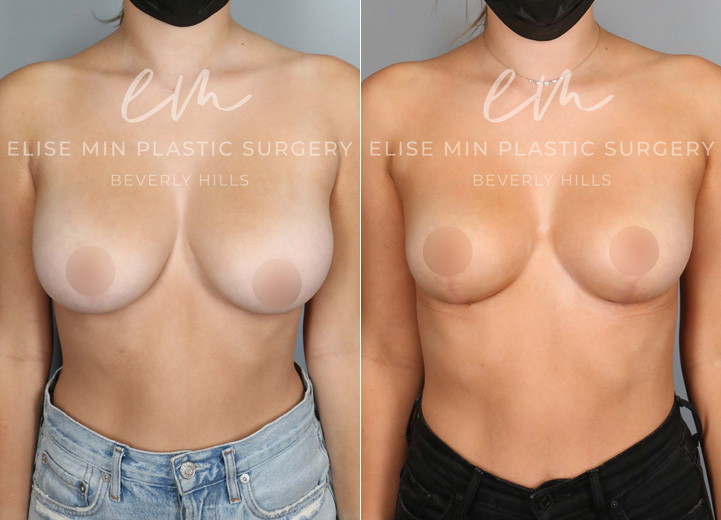
This is a 22 year-old woman with 32DD breasts who felt that her breasts did not match her petite torso. She was experiencing neck and back pain and ideally wanted to be a C cup. The patient underwent a small breast reduction (130g removed from each breast), which included a breast lift procedure. She had the procedure done using a minimal scar approach with a lollipop incision. This is a good example that every breast reduction patient receives a breast lift procedure to achieve perkier breasts.
Case Study #2: Breast Reduction DDD to C Cup
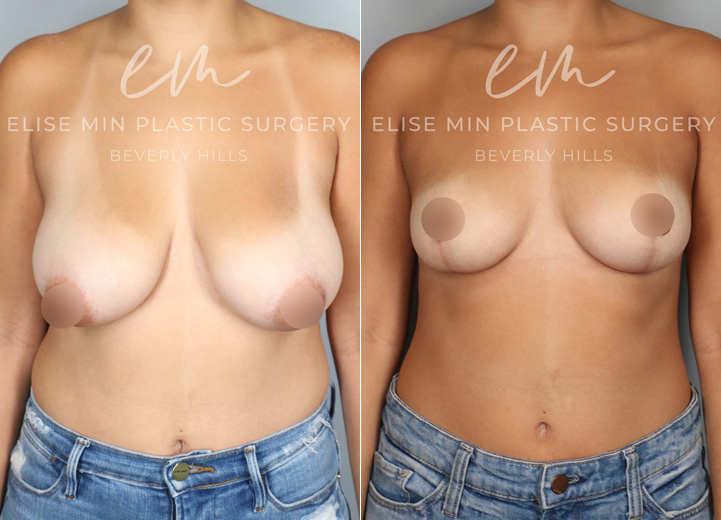
This is a petite 33-year-old woman who had been considering a breast reduction procedure for many years. She felt that her breast size did not match her petite frame and experienced the weight of her droopy breasts affecting her posture over the years. She underwent a vertical breast reduction with the minimal scar approach (‘lollipop’-scar) and had 173g removed from the left breast and 139g removed from the right breast. She went from 30DDD cup-sized breasts to her desired C cup-size after the procedure. She was excited to share that her posture improved, and feeling a lot lighter in the chest, she’s enjoying not wearing a bra at all.
Case Study #3: DD to C Reduction with Internal Bra
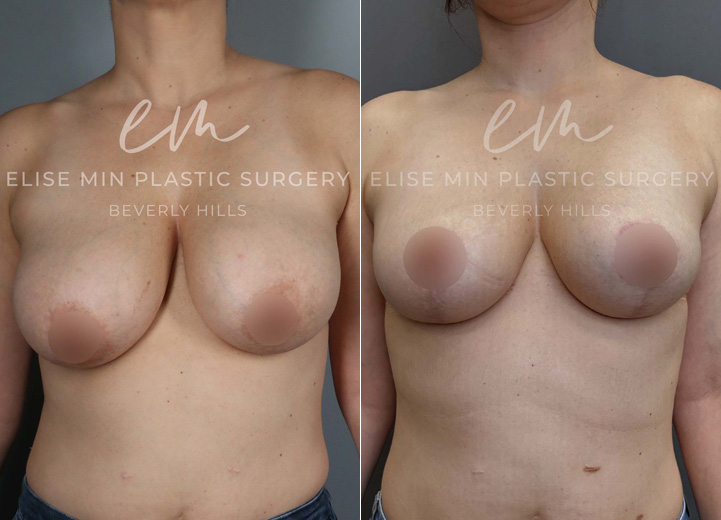
This 40-year-old patient had DD-sized breasts and desired a C cup for a lighter, more comfortable fit. She underwent a breast reduction, with 250g and 270g of tissue removed from each breast, achieving a more proportionate shape. To enhance long-term support, she also opted for synthetic absorbable mesh (Galaflex) as an internal sling, often called an “internal bra.”


